
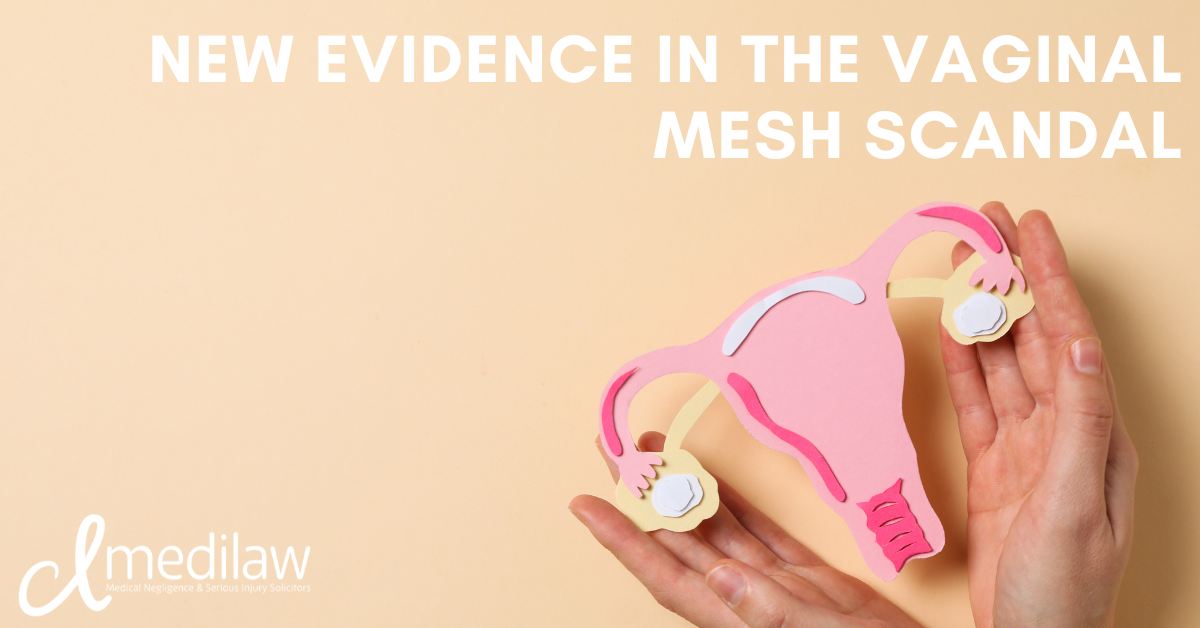
A study published this week by the University of Sheffield has shown more damning evidence of the dangers of vaginal mesh, resulting in campaigners calling for urgent action from the medical community and regulators. The outcome of the study has already led to an immediate halt on the use of mesh implants in Scotland.
What is a Transvaginal Mesh Implant?
Transvaginal mesh implants have been used to treat pelvic organ prolapse and stress urinary incontinence since the mid-1990s, but evidence emerged not long after which showed that it can cause debilitating harm to some women.
It became apparent that the mesh was prone to eroding through the vaginal wall causing pain, vaginal discharge or bleeding, vaginal infections or pain during sex. More serious complications included the mesh damaging the bowel and bladder leading to the need for a colostomy or urostomy.
As a result, in July 2018, a period of restriction was put in place regarding the use of vaginal mesh in England. This restriction was extended in 2019 and remains in place.

Research Highlights Urgent Need For ‘Safer Alternatives’
The focus of the research undertaken at the University of Sheffield was to determine why the problems with mesh arose. The results showed that the material, commonly used in vaginal mesh implants, starts to degrade within 60 days of being implanted in the pelvis. Researchers also found particles of polypropylene, a type of thermoplastic, in the tissue surrounding implant sites.
In short, the research shows that mesh is not suitable for implantation in the pelvis. Our vaginal mesh lawyers have been arguing for many years that mesh was not appropriately tested for its suitability for implantation in the vagina and that there was an incorrect assumption that given the success of mesh used to treat abdominal hernias, the same would work equally well in the vagina. The study has now proven this to indeed be the case.
Study lead Dr Nicholas Farr, research fellow at the University of Sheffield, said: ‘Our results provide strong evidence of the instability of polypropylene and offer new insights into the mechanisms that contribute to its degradation within the body. It is my hope that the insights from this study will be recognised by current, and future, mesh manufacturers and will contribute to the ongoing development of safer alternatives.’
Recent Compensation for Vaginal Mesh Survivors
This new evidence comes shortly after three major mesh manufacturers recently agreed to pay compensation to more than 100 women who had been harmed by mesh.
The women, whose case constitutes the first successful product liability group claim in England, agreed a settlement with the manufacturers Johnson & Johnson, Bard, and Boston Scientific. They claimed the implants, which are for stress urinary incontinence and prolapse, caused infection, bleeding, chronic pain, bladder and bowel perforations, and problems urinating, among other complications.
Vaginal Mesh Doctor Suspended
Adding to the vaginal mesh scandal, last week, Professor Sohier Elneil, a surgeon hailed as a hero for saving mesh injured women, was found guilty of serious misconduct and dishonesty over her treatment of a Scottish patient. The Medical Practitioners Tribunal found that Professor Elneil, who works at University College Hospital, London, had been dishonest about whether she had fully removed the mesh from a patient.
Given that mesh firmly embeds itself in the vaginal tissue, it is rare that it is possible to remove it in its entirety. Professor Elneil is known for reassuring patients that she has removed all of the mesh when this is not in fact the case. This led to many patients wrongly being under the impression that they no longer had any mesh in their body and then feeling devastated when they later discovered that not all of the mesh had been removed.

CL Medilaw partner and expert in women’s health litigation, Elise Bevan, brought a claim against Professor Elneil on behalf of one of her former patients, which was heard in the Royal Courts of Justice earlier this year.
The judge in the case criticised Professor Elneil for altering the patient’s notes, which she described as “an indicator of untruthfulness”, and awarded her substantial compensation.
How can we help?
Our team specialise in women’s health and have extensive experience in bringing claims for women who have suffered complications as a result of the use of mesh. We understand the life-changing consequences that mesh can cause and we can support you with pursuing a claim for compensation for the injuries you have sustained.
If you believe you have experienced an injury as a result of vaginal mesh, contact Elise Bevan, or, alternatively, contact us through our contact form.
Related Posts

For over 30 years, CL Medilaw has been helping people who have been injured by a medical mistake or a serious accident. Many of [...]

MPs used the Baby Loss Awareness Week debate on 12th October 2026 to press for accountability, consistent bereavement support, and measurable improvements in maternity [...]

Shoulder dystocia during delivery is one of the most serious complications that affects mothers in labour. However, unlike many other birth injuries, it is [...]
Saturday 26th of September marked an important step forward in the independent review of maternity and neonatal care at Leeds Teaching Hospitals NHS Trust, [...]

County Durham and Darlington NHS Foundation Trust revealed last week that they were carrying out an internal review of their breast cancer services following [...]
The Thirlwall Inquiry has published its final report into events at the Countess of Chester Hospital, finding a “complete failure to protect babies” on [...]

Concerns about maternity and neonatal care at Leeds Teaching Hospitals NHS Trust have been building for several years, leading to the launch of an [...]

When a baby is deprived of oxygen during pregnancy, labour, or birth, families are often left searching for answers long after leaving the hospital. [...]