
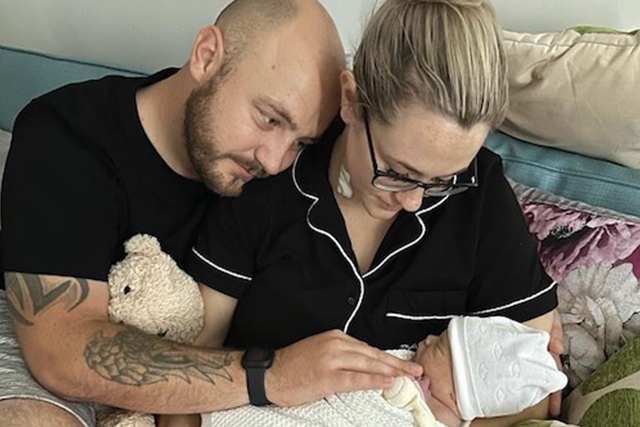
An inquest opens today at Avon Coroner’s Court into the tragic death of baby Mabel Williams, who died aged just 6 days old. The hearing will examine serious concerns about the maternity care provided to her mother, Rebecca Williams, during pregnancy and labour, and how these may have contributed to Mabel’s death.
Mabel’s Story
Rebecca and Tom Williams were eagerly awaiting the arrival of their first baby together — a little girl they had already lovingly named Mabel.
As Rebecca had previously delivered a son via caesarean section, she was offered a vaginal birth in this pregnancy, known as a VBAC delivery (Vaginal Birth After Caesarean). However, VBAC delivery is associated with certain risks, including uterine rupture, which can pose significant danger to both mother and baby. The inquest will explore whether Rebecca was fully informed about the risks of VBAC delivery, including the potential VBAC risk factors and alternative options for delivery.
On the day of Mabel’s birth, Rebecca was admitted to hospital to have labour induced. Sadly, something went tragically wrong. Despite signs that Mabel was in distress and being deprived of oxygen, there were reportedly significant delays in responding. By the time Mabel was born, she had suffered severe brain damage due to oxygen deprivation and developed hypoxic ischaemic encephalopathy (HIE). Mabel tragically died on 10 September 2023, six days after her birth.
HSIB Investigation Raises Serious Concerns
An independent investigation by the Healthcare Safety Investigation Branch (HSIB), now known as Maternity & Newborn Safety Investigations (MNSI), raised multiple concerns about the standard of care Rebecca received. Investigators questioned whether she had been provided with sufficient information to make a fully informed decision about her birth options and whether the VBAC delivery risks were properly communicated. They also highlighted failures to escalate Mabel’s condition when she showed clear signs of distress — a delay that may have ultimately cost her life.
At the inquest, Assistant Coroner Mr Robert Sowersby will hear from the medical staff involved to determine how Mabel, a healthy and much-longed-for baby, died — and whether her death could have been prevented with better care and clearer communication about the risks associated with VBAC.
CL Medilaw Comments
Amy Milner, Senior Associate at CL Medilaw, who is representing Rebecca and Tom Williams, commented:
“This is an extremely tragic case involving alleged failures during both the antenatal period and during labour. Rebecca was not properly informed about the possible risks of VBAC, such as uterine rupture, nor the serious potential consequences to herself and Mabel. There were also delays and missed opportunities during labour that ultimately led to a catastrophic outcome.”
Rebecca and Tom continue to live with the heartbreaking pain of losing their daughter and the knowledge that Mabel’s death may have been avoidable. They hope the inquest will deliver answers and accountability from the NHS Trust involved.
Understanding VBAC Delivery Risks: The Importance of Informed Consent
VBAC (Vaginal Birth After Caesarean) can be a safe choice for many women. However, it does carry specific risks that need careful consideration and proper medical management. Understanding these VBAC delivery risks is essential for expectant mothers making decisions about their birth options.
The Main Risk: Uterine Rupture
The most serious risk with VBAC is uterine rupture. This happens when the previous caesarean scar opens during labour. The chances of this happening are about 1 in 200 births (0.5%). For comparison, women who have never had a caesarean have only a 1 in 10,000 chance. The risk becomes much higher – two to three times more likely – if labour needs to be induced.
What Happens if Uterine Rupture Occurs?
Uterine rupture can cause serious problems for both mother and baby. For the baby, it can lead to distress from lack of oxygen, and in the worst cases, stillbirth or death after birth. For mothers, it can cause dangerous blood loss that requires emergency surgery. In extreme cases, mothers may need a hysterectomy to save their lives.
Safety Requirements for VBAC
The Royal College of Obstetricians and Gynaecologists (RCOG) sets clear guidelines for safe VBAC delivery. A senior doctor must discuss the decision with the mother, considering her individual VBAC risk factors. Most importantly, mothers must be fully informed about the risks of VBAC and know when an emergency caesarean might be needed.
Monitoring During Labour
During VBAC labour, strict safety measures are required. These include continuous monitoring of the baby’s heart rate and dedicated one-to-one care from medical staff. Doctors and midwives watch carefully for warning signs of uterine rupture, such as abnormal readings on baby monitors, abdominal pain, bleeding, or changes in the mother’s heart rate and blood pressure.
The tragic case of baby Mabel Williams shows exactly why proper communication about VBAC delivery risks and following safety protocols are absolutely vital for protecting both mothers and babies.
CL Medilaw represents families across the UK whose children have died or suffered catastrophic harm due to maternity care failures, including those involving VBAC risk factors and complications during delivery.
The family is also being represented by Emily Raynor of Old Square Chambers.
For all enquiries, please contact Amy Milner by email at CL Medilaw or by telephone on 0345 2410 154.
Related Posts

For over 30 years, CL Medilaw has been helping people who have been injured by a medical mistake or a serious accident. Many of [...]

MPs used the Baby Loss Awareness Week debate on 12th October 2026 to press for accountability, consistent bereavement support, and measurable improvements in maternity [...]

Shoulder dystocia during delivery is one of the most serious complications that affects mothers in labour. However, unlike many other birth injuries, it is [...]
Saturday 26th of September marked an important step forward in the independent review of maternity and neonatal care at Leeds Teaching Hospitals NHS Trust, [...]

County Durham and Darlington NHS Foundation Trust revealed last week that they were carrying out an internal review of their breast cancer services following [...]
The Thirlwall Inquiry has published its final report into events at the Countess of Chester Hospital, finding a “complete failure to protect babies” on [...]

Concerns about maternity and neonatal care at Leeds Teaching Hospitals NHS Trust have been building for several years, leading to the launch of an [...]
When a baby is deprived of oxygen during pregnancy, labour, or birth, families are often left searching for answers long after leaving the hospital. [...]